SEP 24, 24 .. PUNCTUATION MARKS..
Over on our Google blogspot website, we published a second Post about our local Laundromat.
I only “half jokingly” wrote :
Does a Post here on Google blogspot have “feelings”? If I was to write at the beginning above.. “Delete This Post Before Reading” would its feelings be hurt?!
https://bobbacaps.blogspot.com/2024/09/sep-23-24-amazing.html
Smiles. Cap and Patti
– – – – – – – –
Punctuation Marks?
Punctuation Marks?
Captain just what gives? This is too strange!
We all can thank Patti, my personal “Word Smith” (a skilled user of words) for this topic.
Had Patti not noticed it, had Patti not started to giggle when she was reading it, we would not have this “Day” today.
“Let’s eat, Grandma!”
Take out the comma (,) it reads..
“Let’s eat Grandma!”
It’s clear punctuation saves lives!
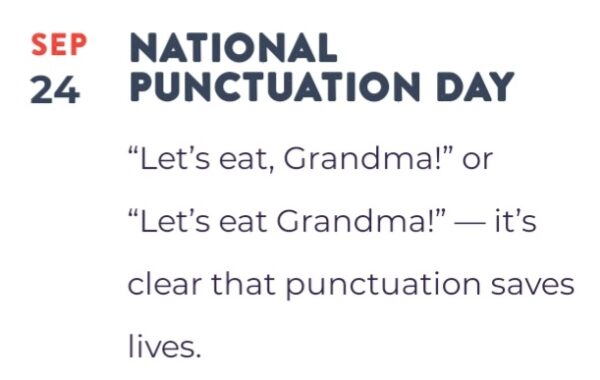
From the lowly comma to the flamboyant ampersand, National Punctuation Day on September 24 celebrates the punctuation that makes our words legible and gets our point across. “Let’s eat, Grandma!” or “Let’s eat Grandma!” — it’s clear that punctuation saves lives. Though you might not have consciously considered punctuation since elementary school, you likely use it every day. Every year, the creator of the holiday sets a punctuation challenge, and punctuation quizzes and games can be found all over the country.
Minding your p’s and q’s, dotting your i’s, crossing your t’s, and knowing the difference between a colon and a semicolon was not always necessary to communicate.
While today we take for granted the little dots, slashes, and spaces that turn a string of unintelligible letters into a compelling story, ancient cultures had to make do without.
Since most early languages were purely verbal, punctuation was not necessary.
The earliest-known document featuring punctuation is the Mesha Stele from 900 B.C. The next civilization to start to develop rudimentary punctuation was the Greeks, in 200 B.C. Though they had previously written in ‘scriptura continua,’ or unending strings of text unmarred by punctuation marks, people soon started to adopt the system of punctuation created by Aristophanes of Byzantium. This included a single punctuation mark positioned differently to indicate pauses in speeches.
Some Tid-bits..
It wasn’t until the Bible began to be printed en masse that punctuation spread to other civilizations. Bible printing was widespread between 400 and 800 A.D., and punctuation was necessary so that those who read the text aloud knew where to pause and place emphasis. In the 1400s, a huge shift came with the printing press, which spurred the need for a more unified punctuation system.
Texting and chatting online requires knowledge of a wholly different, somewhat colloquial body of punctuation rules.
National Grammar Day falls on March 4.
Do you know what ‘#’ is called? You might have said ‘pound’ or ‘hashtag’ (depending on your generation) — little did we know, its official name is an ‘octothorpe’.

Thanks Patti, my very own Word Smith for picking out “Punctuation Day”.
Oops Don’t forget that NATIONAL TODAY / NATIONAL DAY CALENDAR.. Are the sources of most, but not 100%, of the information on our various “Days”.
Cap and Patti
I must confess that when I was looking at my National Day email yesterday, I saw National Punctuation Day and was hoping you would pick it. I love punctuation. A simple period or a carefully placed comma make the world a better place. I read some self-released books occasionally and find myself getting aggravated when the punctuation is sloppy. I was fascinated by the fact that printing the Bible is what made punctuation leap in usage.
I did notice this interesting tidbit in said email:
September 24th Celebrated History
1906
The perpendicular rock formation known as Devil’s Tower is named the first national monument in the United States. The Antiquities Act passed in June of the same year paved the way for President Theodore Roosevelt to begin declaring national monuments. Throughout his term as president, he would declare 17 more national monuments.
Horray for the Antiquities Act.
Wow Kathleen, what an amazing comment BUT it is Patti, and in no way yours truly, who 100% “saved the day” by seeing and then, on her own, read and studied National Punctuation Day. Then began giggling reading that a mere comma saved Grandma!
Now here is Patti.
One of my greatest loves is grammar in ALL of its forms. Punctuation, spelling, diagramming sentences, etc!
Kathleen, I may go back and write more about the National Antiquities Act and President Theodore Roosevelt and The Devils Tower! Fascinating.
Cap and Patti
On the Semicolon
by Gullible
;
Behold the mighty semicolon,
Undaunted, audacious hieroglyphic symbol,
Thy name implies a power halved—
Neither period stop nor comma pause,
But something in between
And rarely understood.
Power halved?
Ah, thy power to strike fear in the heart
of one who dared employ thee
Ranked first amongst thy kindred marks.
Generations feared thee;
generations avoided thee.
Behold the mighty semicolon!
Once upon the slippery slope,
falling inexorably into dis-use,
Rather than mis-use.
Fear not, oh semicolon.
Now is thy time upon the stage.
Thou will not disappear into obscurity,
But live in perpetuity
As a sly and winking emoticon.
;>)
Oh Gullible! What to say in reply to this second amazing comment about National Punctuation Day. Too, far too much for me to put together a semi articulate reply to your one of a kind comment! So I called in Patti to assist me.
Patti says:
Eloquent writing Gullible, and love that the semicolon will live in perpetuity as a sly and winking emoticon!!
Keep the comments coming!
Cap and Patti