APR 28, 25.. CANCER AND ALCOHOL.. CIRCADIAN RHYTHMS and SLEEP..
CANCER and ALCOHOL..
Friends of Bill .. Both Patti and I think that you will be interested in this month’s Post over on Google Blogspot.
Below is a little “Teaser” ..
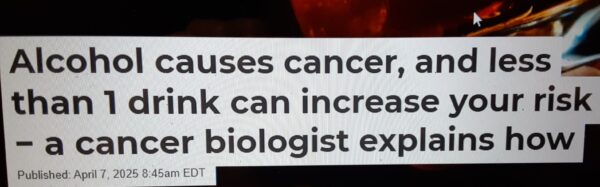
Below is a link to click on if you are interested..
https://aaphotoshere.blogspot.com/2025/04/apr-27-25-alcohol-causes-cancer-pranoti.html
Enough said.
– – – – – – – –
NATIONAL TODAY had a very interesting article about our biological clocks.
Because Patti and I are currently dealing with some challenges over a small, one hour time change between Alaska and Arizona, the article really interested us.

Biological Clock Day is celebrated every April 28 to raise awareness about the circadian rhythm and its impact on our sleep-wake cycle, body system, and mood.
The biological clock (circadian rhythm) is a 24-hour cycle affected by light or darkness. It controls our sleep-wake cycle, body temperature, and hormonal production.
We humans practiced segmented sleep in medieval times before the invention of the electric bulb reduced sleeping hours to six hours? The biological clock is linked with the circadian rhythm, a 24-hour cycle part of our internal clock that carries out essential functions and processes, such as regulating the sleep-wake cycle. The circadian rhythms are connected to a master clock located in the brain that sends signals to regulate activity throughout the body. This master clock is influenced by environmental cues, allowing the circadian rhythms to work based on the day and night cycle.
Sleep is as much a part of the natural process as eating and breathing. Since the beginning of human evolution, we have always needed sleep. And as we experience changes in civilization, human sleeping patterns also change, impacted by cultural shifts, migration, and technological advancements. Our understanding of how early humans sleep is limited, as there is little to no historical evidence of early hunter-gatherer and agricultural societies. However, by observing hunter-gatherer groups in Tanzania, Bolivia, and Namibia, researchers discovered that early humans only slept for about 6.25 hours and rarely woke up during the night. This sleeping pattern changed when humans migrated to Europe, where they experienced longer nights, leading to segmented rest.
It’s possible to change your biological clock. First, you need to understand your sleep-wake cycle, set a sleep schedule, and gradually move your bedtime. Exercising, avoiding alcohol and caffeine in the evening, and limiting screen time can help change your biological clock.
It is important to take your Sleep seriously. Sleep offers a world of benefits when given the proper priority. Pushing it down to the least important section of your schedule could lead to drastic implications for your health and relationship.
Humans spend an average of one-third of their life sleeping.
According to research, many people dreamt in black and white before the introduction of colored television. Kind of amazing to us.
Within five minutes of waking up, we forget about 90% of what we dreamt about. All of us know this is a fact.
While prolonged and severe sleep deprivation can contribute to health problems and potentially shorten lifespan, it’s extremely rare for lack of sleep to directly cause death in humans. However, sleep deprivation can increase the risk of serious health issues, accidents, and even death due to the effects of those issues.
Cutting down your sleeping hours can reduce your pain threshold. The problem is: Pain can prevent you from sleeping.
If you want further information, please click onto the below link.
https://nationaltoday.com/biological-clock-day/
– – – – – – –
By The Way.. Last March the 14th, 2025, we also published a Post dealing with sleep and sleeping.
But today’s Post was still interesting to us.
– – – – – – – –
Cap and Patti
When I first say “biological clock”, I was thinking of the proverbial woman’s biological reproduction clock. So when you started out with your biological clock, I was a bit flummoxed.
My sleep clock has a pretty regular bed time. However, wake up time can be anywhere from 4 am to 8 am (rarely past 7 though). Sometimes my body refuses to go back to sleep after one of my early awakenings. Or when a cat coughs up a hairball in the bedroom. That always gives me a shot of adrenaline. And my sleep clock can not be bothered to let me sleep through the night. There must be several trips to the bathroom and an hour or two of lost sleep. Oh the good old days when I fell asleep within minutes and didn’t wake up until the alarm clock went off. At least two decades ago.
Oh Yes Kathleen! You said it when you wrote: Oh the good old days when I fell asleep within minutes and didn’t wake up until the alarm clock went off. At least two decades ago. Right On Kathleen! Oh The Good Old Days. Cap and Patti